You Did the UX Research. Users Still Complain. Here’s Why.
Here’s a scenario every product team has lived through: you run interviews, shadow users, map their pain points, redesign the flow, ship it… and three months later, the same complaints show up in your support tickets.
The button is prettier. The flow is shorter. Users still hate it.
So what happened?
Usually, the answer is that your UX research did exactly its job, it told you what users need and where they struggle. But nobody looked at what happens after the user hits “confirm.” And that’s precisely where Service Design comes in.
UX Research Tells You Why, Flow by Flow. Service Design Tells You How, System-Wide.
UX research is brilliant at answering “how does this feel for the user?”, one flow at a time. It gives you personas, journey maps, and a long list of validated pain points, but usually flow by flow. What it doesn’t automatically show you is how those individual pain points connect into one broken system, the backend handoffs, internal processes, and approval chains that span multiple journeys and that the user never sees but always feels.
Real-world example: A fintech app’s UX research revealed that users felt anxious during KYC verification. The team redesigned the screen with clearer copy, a progress bar, and reassuring microcopy. Anxiety scores barely moved. Why? Because the real issue wasn’t the screen. It was that verification silently sat in a manual review queue for 48 hours with zero status updates. No amount of UI polish fixes a backstage process problem.
That’s the gap Service Design was built to close.
So What Exactly Is Service Design?
Service Design looks at the entire system that delivers an experience, not just the screen the user is looking at. It maps every actor, system, and handoff involved in delivering value: the front-of-stage (what the user sees and touches) and the back-of-stage (the APIs, teams, databases, and processes working behind it).
Think of it this way:
- UX Design asks: “How do we make this interaction easier?”
- Service Design asks: “What happens behind the scenes the moment the user acts, and how do we make that whole chain work?”
A single “Submit” click can quietly trigger a backend system, a database update, a manual review, a support ticket, another department, and a notification back to the user. The user never sees any of that. But they absolutely experience the consequences, whether that’s a fast, seamless confirmation or three days of radio silence.
Why Service Design Is the Natural Next Step, Not a Separate Project
Here’s the part clients often miss: Service Design isn’t “advanced UX” or a nice-to-have add-on. It’s the logical continuation of research you’ve already invested in.
- Your research already surfaced the backstage problems, you just didn’t call them that.
If your interviews turned up phrases like “I never know what’s happening with my request” or “support gave me a different answer than the app,” that’s not a UI problem. That’s a Service Design problem hiding inside your UX findings.
- Personas and journey maps only cover the front-of-stage.
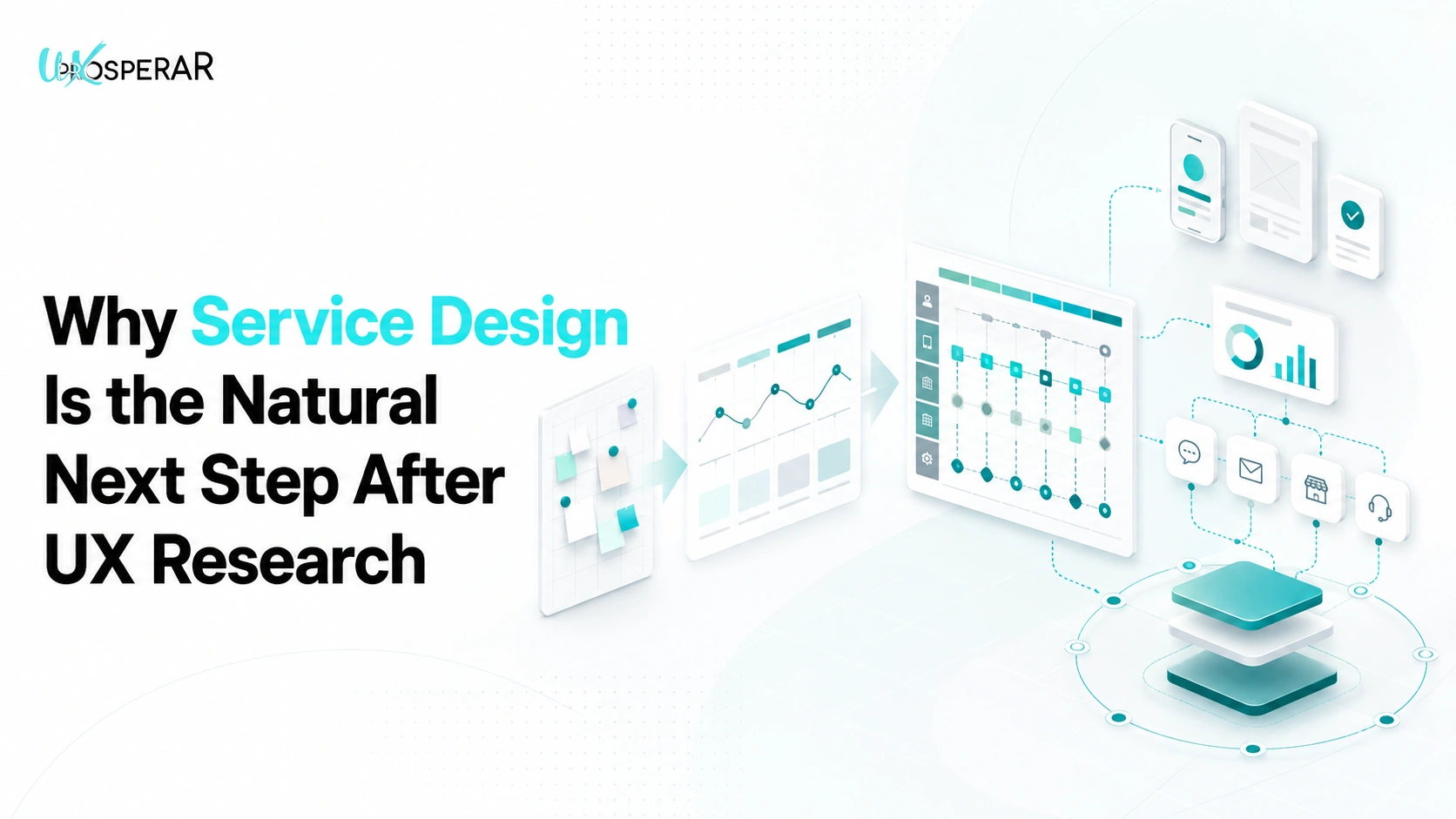
A customer journey map shows what the user does and feels at each step. Service Design extends that same map backstage, showing which team, system, or process is responsible for making each step actually happen. Without that layer, your journey map is really just half a map.
- Fixing the interface without fixing the system just moves the friction, it doesn’t remove it.
Real-world example: An e-commerce brand’s UX research found that users abandoned returns halfway through the process. The team simplified the returns form. Abandonment barely improved. The real culprit: once submitted, a return request bounced between three internal teams (warehouse, finance, and support) with no shared visibility, so refunds took 12–15 days. Service Design mapped that internal handoff, cut it down to one team with clear ownership, and refund time dropped to 3 days. Abandonment fell along with it.
What Moving From UX Research to Service Design Actually Looks Like
You don’t need to throw away your research to do this, you build on top of it.
- Revisit your research through a “backstage” lens. Go back through interview notes and support tickets looking specifically for moments where the user’s frustration wasn’t about the screen, it was about waiting, confusion after an action, or inconsistent answers across channels.
- Map the full service blueprint. Lay out every touchpoint (front-of-stage) alongside the systems, teams, and processes that support it (back-of-stage), plus where they connect and where they break.
- Identify ownership gaps. Many backstage failures happen because no single team owns the end-to-end experience, they own their slice of it. Service Design makes those gaps visible.
- Redesign the system, not just the screen. Fix the handoffs, automate the manual reviews, close the communication gaps, then let UI/UX design express that improved system cleanly.
- Test the whole chain, not just the interface. Validate that the promise made on-screen (“Refund in 3 days”) actually matches what happens behind it.
Signs You’re Ready for Service Design
If any of these sound familiar, your UX research has already told you it’s time:
- Users report inconsistent answers from your app vs. your support team
- “It’s stuck” or “I don’t know what’s happening” shows up repeatedly in feedback
- Two near-identical competitor products deliver very different experiences, and you can’t figure out why
- Your journey map ends at “user submits form” with nothing mapped after it
- Fixing the UI hasn’t moved the metric you expected it to move
The Bottom Line
UX research shows you where users struggle. Service Design shows you why that struggle exists and gives you the tools to fix it at the source, not just paper over it with a better interface. If your research has already surfaced friction that a redesign alone can’t solve, Service Design isn’t the next trend to chase. It’s the next, necessary step.
Ready to Look Behind the Button?
If your UX research keeps surfacing problems your interface can’t fix on its own, it’s probably time to map what’s happening backstage. Our team at UX Prosperar works across research, strategy, and design to help brands close exactly this gap, from insight to a service that actually delivers on what your interface promises.
Let’s chat about your next step
Frequently Asked Questions
1. Is Service Design just a fancier name for UX Design?
No. UX Design focuses on the interaction between a person and a product. Service Design covers the entire system, people, processes, and technology, that delivers the experience behind that interaction. They work together, but they solve different problems.
2. Do I need to redo my UX research before starting Service Design?
Usually not. Most of what you need is already sitting in your existing research. Service Design typically starts by re-examining that research for backstage clues, then extending your journey maps to include the systems and teams behind each step.
3. My interface tests well in usability studies. Why would I still need Service Design?
Usability testing tells you if users can complete a task on-screen. It won’t tell you if the refund actually arrives in 3 days, or if your support team can see what your app promised. If the disconnect is happening after the click, Service Design is what closes it.
4. Is Service Design only relevant for large, complex organizations?
Not at all. Even a small team can have a two-day-late notification system or a manual approval step that quietly wrecks the experience. Service Design scales down just as effectively as it scales up.
5. How long does a Service Design project typically take?
It depends on how many touchpoints and internal teams are involved, but most engagements run from a few weeks for a focused service blueprint to a couple of months for a full end-to-end redesign across multiple departments.
6. What’s the first deliverable I should expect?
Typically, a service blueprint, a visual map showing every front-of-stage and back-of-stage step, the systems and teams involved, and where the gaps or breakdowns are happening.
Typical project duration: 4–8 weeks, depending on scope.

At UX Prosperar, we don’t believe in one-size-fits-all. Every project has its own goals, users, and challenges, so the services we use depend on your specific requirements. Here’s how our offerings fit together to create products that both look stunning and work flawlessly.
1. UI/UX Design for Web, Mobile & SaaS
We design responsive, conversion-focused interfaces that adapt seamlessly across devices and platforms, whether it’s a corporate website, a mobile app, or a SaaS dashboard.
Often paired with:
- UX Research to understand your users before designing
- Wireframing to map the user journey before final visuals
2. UX Design and Research
Before any pixels are drawn, we dig into user interviews, usability testing, competitor analysis, and data review. This ensures every design choice is validated and goal-driven.
Often paired with:
- Customer Journey Mapping to align every touchpoint
- Usability Studies for deeper, real-world user insights
3. User Interface Design & Product Design
We simplify complex workflows into clear, user-friendly interfaces, from mobile apps to enterprise software. Our goal is to make interaction effortless and intuitive.
Often paired with:
- Design Sprints to rapidly prototype and validate ideas
- Content Strategy & UX Copywriting to ensure words guide users naturally
4. Product Design Services & Product Development Consulting
For startups and enterprises, we can support the entire journey, from early ideation to launch. You decide how deep we get involved.
Often paired with:
- Wireframing & Prototyping for early validation
- Usability Testing before development investments
5. Wireframing & Interactive Prototypes
Before code, we bring your product to life in clickable prototypes. This lets you test, iterate, and refine early, saving development time and cost.
Often paired with:
- UX Research to validate the flow with real users
- Design Systems to ensure consistency when scaling
6. Usability Testing & Usability Studies
We go beyond theory. We put your product in front of real users and watch how they interact. From quick hallway tests to in-depth usability studies, we gather insights that refine your product to be intuitive, smooth, and conversion-friendly.
Often paired with:
- UX Audits for a full product health check
- Customer Journey Mapping to ensure every touchpoint works together
7. Customer Journey Mapping
We map every step your users take before, during, and after using your product. This ensures all touchpoints feel connected and intentional.
Often paired with:
- Content Strategy / UX Copywriting to guide actions
- UI Design to visually align with the journey
8. Content Strategy / UX Copywriting
The right words help users take the right action. We craft microcopy, onboarding text, CTAs, and content flows that improve usability and conversions.
Often paired with:
- Design Sprints to test language quickly
- UI Design for perfect visual-text alignment
9. Design Sprints
When you need to move fast without compromising quality, we run focused 4-5 day sprints to rapidly ideate, design, prototype, and test ideas.
Often paired with:
- Wireframing & Prototyping for sprint outcomes
- Usability Testing to validate the sprint output
10. UX Audits
Is your product underperforming? We analyze it from usability, accessibility, and conversion standpoints to identify and fix issues.
Often paired with:
- Usability Testing for deeper user insights
- Customer Journey Mapping to spot big-picture issues
For some clients, the focus might be solely on UX Research + Wireframes. For others, it’s a full end-to-end process from research to product launch. The service mix is tailored to your goals, budget, and timeline. Each service is designed to work seamlessly with others for maximum impact.
UX Prosperar: UI/UX Design Agency With a Difference
- Consistent & Scalable Design Systems that grow with your product
- Cross-Device UX & UI Design Services for mobile, web, desktop, and SaaS
- Fast Prototyping & Iteration: see results early and often
- Developer-Ready Assets for smooth handoff and faster builds
Why Choose UX Prosperar for UI/UX Design?
Most agencies focus only on visuals. We start with research-led UX design, understanding your users, your business model, and your market, so your product doesn’t just look great, it performs.
Here’s why our clients love working with us:
- User-Friendly Interfaces – Websites, apps, and dashboards that feel effortless & responsive to use
- Scalable Design Systems – Future-proof designs that grow with your product
- Developer-Ready Deliverables – Clear, organized assets for smooth handoff
- Fast & Transparent Process – See results early, give feedback often
Industries We Serve
SaaS • E-Commerce • FinTech • HealthTech • Logistics • B2B Tools • Corporate Websites
Let’s Design a Product Your Users Will Love
Don’t risk launching a product that confuses users or loses them at the first click.
With UX Prosperar’s UI/UX strategic design services, you’ll get a hybrid, responsive, and scalable design backed by real user insights.
Book Your UX Audit Today
Let’s talk about how we can turn your digital product into something people want to use.