
AI has made building almost free. That’s exactly why knowing what to build has become the hardest, and most valuable, part of the job.
If you’ve spent any time in a product or design team meeting in 2026, you’ve probably heard some version of this argument: “Why run discovery research when we can just prototype it, ship it, and see what sticks?” With tools like Cursor, Lovable, v0, and Claude turning ideas into working software in hours instead of months, it’s a fair question. When building is cheap, why not skip the upfront research and let real usage data decide what survives?
At UX Prosperar, we work with product and design teams across Dubai, the UAE, and the wider MENA region who are asking exactly this question, often under pressure to move faster with smaller teams. Our answer, based on running discovery research for brands like Careem, OLX, Domino’s, and Hero MotoCorp, is a firm no: discovery research isn’t becoming obsolete. It’s becoming the single most valuable filter a team has, precisely because everything else got faster.
Here’s why, and how to think about research in a world where prototyping is nearly instant.
What is discovery research, and why does the “AI killed it” argument keep coming up?
Discovery research (sometimes called generative or formative research) is the upfront work UX teams do to understand a problem before anyone designs or builds a solution, interviews, contextual inquiry, diary studies, competitive teardown, mining existing data for patterns. It maps to the first half of the classic Double Diamond process: diverge to understand the problem space, then converge on what’s worth solving.
The argument for retiring it goes like this: engineering cost is collapsing, AI coding tools can spin up a working prototype almost instantly, so instead of spending weeks on generative research, teams should build several options, put them in front of real users, and let a continuous test-and-learn loop decide what stays.
It’s a reasonable instinct. It’s also solving for the wrong constraint.
Why cheaper building makes discovery research more valuable, not less
The logic behind “skip discovery” quietly assumes that the expensive part of product development was always building. For most of software’s history, that was roughly true, engineering time was the bottleneck, so teams rationed it carefully, and discovery research existed partly to make sure that scarce engineering effort wasn’t wasted.
AI has broken that assumption. Building four versions of a feature this week is genuinely realistic for many teams now. But the question was never really “can we build it.” It has always been “is this worth building at all”, and that question doesn’t get any easier just because the build step got cheaper. If anything, it gets harder, because now there are more plausible directions to choose between, not fewer.
Think of discovery research as a filter, not a bottleneck. Its job was never to slow teams down for its own sake, it was always there to stop teams from spending scarce resources on the wrong thing. When “scarce resource” shifts from engineering hours to something else, user trust, market attention, team focus, the filter becomes more important, not less, because the cost of guessing wrong hasn’t gone away. It’s just moved.
The hidden cost of “just build it and see”
Teams that lean fully into build-and-test-everything tend to underestimate two costs:
- Testing itself isn’t free. Every prototype you put in front of users draws on a finite, often hard-to-recruit pool of participants, this is especially true in B2B and enterprise contexts, where getting one decision-maker on a call can take weeks, let alone four separate studies for four separate ideas. Synthetic or AI-simulated users don’t solve this: they reflect patterns in training data, not the judgment, context, or edge cases of your actual customers.
- What ships doesn’t disappear. Every feature that survives a test-and-learn loop and stays in the product adds to long-term maintenance burden, interface complexity, and cognitive load for users, a kind of compounding “product tax” that outlasts the sprint it was built in. Shipping fast doesn’t remove this cost; it just defers it.
None of this means build-and-test is wrong. When a feature is cheap, reversible, and low-stakes, shipping a version and watching what happens is often the fastest way to learn, and a legitimate research method in its own right. The problem is applying that logic indiscriminately, to decisions that are expensive to reverse or where teams are choosing between many plausible directions. That’s precisely the situation cheap, AI-assisted building creates more of, not less, which means the need for a decisive first filter goes up, not down.
Where AI genuinely helps discovery research
To be clear, AI hasn’t left discovery research untouched, it’s changed the shape of the work, mostly for the better, in the parts of the process that involve processing information you already have:
- Mining existing knowledge faster. AI tools can now sift through support tickets, sales call transcripts, CRM notes, and past research repositories to surface recurring pain points, work that used to mean manually tagging a random sample of hundreds of tickets by hand.
- Faster synthesis of new research. Transcription, initial theme-tagging, and quote-pulling from interviews, the mechanical, time-consuming part of qualitative analysis, can now happen in a fraction of the time.
- Clearing the “known” faster. By quickly establishing what your existing data already tells you, AI lets research teams retire redundant questions and focus scarce field time on genuine unknowns.
This matters most for teams juggling many stakeholders and a backlog of “we probably already have data on this” questions, which describes most enterprise UX teams we work with.
What AI still can’t do for discovery research
Here’s the catch, and it’s an important one: AI is excellent at synthesizing what your organization already knows, and structurally blind to what it doesn’t. Support tickets, sales calls, and old research transcripts are all records of existing users describing problems your product already touches. None of that tells you about shifting behaviors, users who quietly churned without filing a ticket, or needs nobody has ever articulated because they don’t know a better way exists.
Mining your internal data doesn’t reduce the need for original, field-based discovery research, it redirects it, pointing your limited research capacity at the gaps automated synthesis genuinely can’t reach.
The parts of research that still resist automation include:
- Recruiting and scheduling real participants – especially in B2B, where the slow part was never the analysis, it was getting the right person on a call.
- Judgment on AI output – generative tools can hallucinate themes, flatten nuance, and lift quotes out of context, so a trained researcher still has to be the check on what the AI concludes.
- Storytelling and influence – turning findings into a narrative that actually shifts a roadmap decision remains a distinctly human skill, tied to business context that lives with experienced researchers, not in a transcript.
How AI is reshaping the second half of the process: evaluative research
If discovery research (the first half of the Double Diamond) is holding its ground, the second half, evaluative research and development, is changing shape fast.
The prototypes AI tools produce today aren’t clickable wireframes anymore; they’re working, interactive builds you can put in front of real users within hours. That changes evaluative research in three concrete ways:
- The aperture widens. Teams can test several alternatives in parallel instead of betting early on one direction.
- The loop compresses. Test-learn-revise cycles that used to take weeks can now take days.
- The old forcing function for convergence disappears. Teams used to converge because they could only afford to build one option. When you can afford to build ten, that scarcity-driven discipline vanishes, and has to be replaced deliberately with evidence and judgment, or development simply sprawls without direction.
This is exactly why discovery research still earns its place even in a build-fast world: it’s what decides which few ideas are worth the evaluative effort in the first place, keeping teams from testing every idea instead of the best ones.
For AI-powered products specifically, there’s a further wrinkle: because AI system behavior is non-deterministic, it can’t be fully validated before launch the way a traditional, rule-based feature can. Real usage, real people pushing unpredictable inputs through the system, is often the only way to surface how it actually behaves. That’s part of why structured evaluation of AI outputs, sometimes called AI evals, has become one of the most in-demand UX research methodologies of the past year: testing has to continue through and past launch rather than stopping at a pre-launch sign-off.
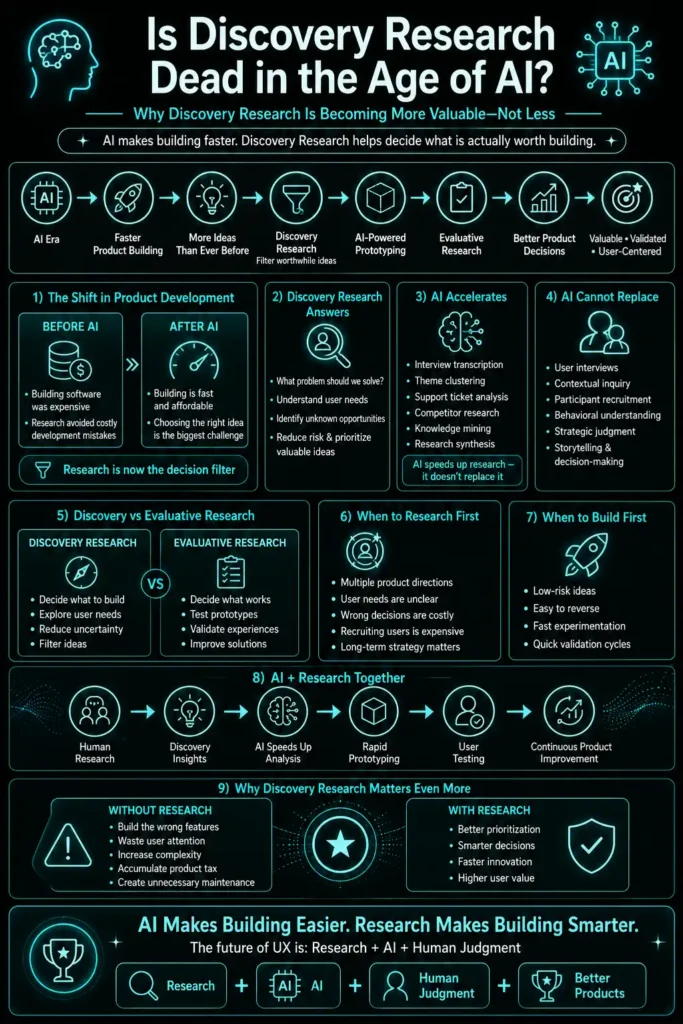
Discovery research vs. evaluative research: what changes with AI
Discovery (Diamond 1) | Evaluative (Diamond 2) | |
Core question | What’s worth building? | What’s worth keeping? |
Effect of cheap AI building | Becomes more decisive, more options to filter, same cost of being wrong | Becomes wider, more alternatives can be tested in parallel |
What AI speeds up | Mining existing data, transcription, theme-tagging | Prototyping speed, test-learn cycle time |
What AI can’t replace | Field research into unknowns, recruiting, judgment, storytelling | Human interpretation of non-deterministic AI behavior post-launch |
Risk if skipped | Wasted build effort, user fatigue from testing too many ideas, accumulating “product tax” | Development sprawl with no convergence discipline |
A practical framework: when to research first and when to just build
Based on our work across product, e-commerce, and service-design engagements, here’s a simple test we use with clients before deciding whether a decision needs discovery research or can go straight to a build-and-test loop:
- Is the decision reversible and low-stakes? If yes, and the cost of being wrong is small, prototype and test directly, that’s a legitimate, efficient path.
- Are you choosing between several plausible directions? If yes, discovery research earns its cost by narrowing the field before you spend build and testing resources on all of them.
- Is testing expensive in your context? In B2B or enterprise settings where recruiting takes weeks, testing every idea isn’t realistic, discovery research does the narrowing that scarce testing capacity can’t.
- Does the feature involve AI or non-deterministic behavior? If yes, plan for evaluation to continue past launch, not just before it, a one-time pre-launch test won’t be enough.
- Have you actually mined what you already know? Before commissioning new field research, check support tickets, past studies, and sales conversations, AI tools can surface what’s already answered in hours, freeing your team’s time for genuine unknowns.
Key takeaways
- Discovery research isn’t dead, its relative value has gone up as building got cheaper, because the constraint shifted from engineering time to knowing what’s worth building.
- AI is genuinely useful for mining existing knowledge and speeding up research synthesis, but it can’t uncover unknowns, recruit real participants, or replace researcher judgment and storytelling.
- Evaluative research (testing built prototypes) is where AI changes the game the most, faster loops, more parallel options, and for AI products, evaluation that continues past launch.
- The two diamonds aren’t disappearing, they’re rebalancing: discovery decides what’s worth building; evaluation decides what’s worth keeping.
FAQs about discovery research in the AI era
1. Is discovery research still necessary if I can prototype with AI in hours?
Yes. Faster prototyping only speeds up how quickly you can test an idea, it doesn’t tell you whether that idea is worth testing in the first place. Discovery research remains the step that narrows many possible directions down to the ones worth the cost of building and testing.
2. Can AI replace UX researchers entirely?
Not currently. AI tools are strong at processing information your organization already has, transcripts, tickets, past research, but they can’t recruit real participants, uncover needs nobody has ever articulated, or reliably judge which findings actually matter to your business. Human researchers remain the check on AI-generated themes and the ones who turn findings into a narrative stakeholders act on.
3. What’s the difference between discovery research and evaluative research?
Discovery (generative) research happens before you build anything and focuses on understanding the problem and deciding what’s worth pursuing. Evaluative research happens after you have something to test, a prototype or live feature, and focuses on whether it actually works for users.
4. How has AI changed evaluative research specifically?
AI-generated prototypes are interactive and near-production-quality almost immediately, so teams can test more alternatives in parallel and shorten test-learn-revise cycles from weeks to days. For AI-powered products, evaluation also has to continue after launch, since AI behavior can’t be fully predicted before real users interact with it.
5. How do I know if my team needs discovery research before this project?
As a rule of thumb: if the decision is cheap to reverse and low-stakes, you can often build and test directly. If you’re choosing between multiple plausible directions, if testing with real users is expensive or slow in your market, or if being wrong would be costly to undo, discovery research will save you more time and budget than it costs.
Need help deciding where research fits in your product roadmap?
At UX Prosperar, we help product and design teams across the UAE and MENA region figure out exactly where discovery research pays for itself, and where it’s safe to build first and learn fast. Our research-led approach has shaped digital experiences for brands including Careem, OLX, Domino’s, and Hero MotoCorp.
Talk to our team about your next project →
Explore our Discovery Research services or read more on common UI/UX design mistakes hurting conversion.
Typical project duration: 4–8 weeks, depending on scope.

At UX Prosperar, we don’t believe in one-size-fits-all. Every project has its own goals, users, and challenges, so the services we use depend on your specific requirements. Here’s how our offerings fit together to create products that both look stunning and work flawlessly.
1. UI/UX Design for Web, Mobile & SaaS
We design responsive, conversion-focused interfaces that adapt seamlessly across devices and platforms, whether it’s a corporate website, a mobile app, or a SaaS dashboard.
Often paired with:
- UX Research to understand your users before designing
- Wireframing to map the user journey before final visuals
2. UX Design and Research
Before any pixels are drawn, we dig into user interviews, usability testing, competitor analysis, and data review. This ensures every design choice is validated and goal-driven.
Often paired with:
- Customer Journey Mapping to align every touchpoint
- Usability Studies for deeper, real-world user insights
3. User Interface Design & Product Design
We simplify complex workflows into clear, user-friendly interfaces, from mobile apps to enterprise software. Our goal is to make interaction effortless and intuitive.
Often paired with:
- Design Sprints to rapidly prototype and validate ideas
- Content Strategy & UX Copywriting to ensure words guide users naturally
4. Product Design Services & Product Development Consulting
For startups and enterprises, we can support the entire journey, from early ideation to launch. You decide how deep we get involved.
Often paired with:
- Wireframing & Prototyping for early validation
- Usability Testing before development investments
5. Wireframing & Interactive Prototypes
Before code, we bring your product to life in clickable prototypes. This lets you test, iterate, and refine early, saving development time and cost.
Often paired with:
- UX Research to validate the flow with real users
- Design Systems to ensure consistency when scaling
6. Usability Testing & Usability Studies
We go beyond theory. We put your product in front of real users and watch how they interact. From quick hallway tests to in-depth usability studies, we gather insights that refine your product to be intuitive, smooth, and conversion-friendly.
Often paired with:
- UX Audits for a full product health check
- Customer Journey Mapping to ensure every touchpoint works together
7. Customer Journey Mapping
We map every step your users take before, during, and after using your product. This ensures all touchpoints feel connected and intentional.
Often paired with:
- Content Strategy / UX Copywriting to guide actions
- UI Design to visually align with the journey
8. Content Strategy / UX Copywriting
The right words help users take the right action. We craft microcopy, onboarding text, CTAs, and content flows that improve usability and conversions.
Often paired with:
- Design Sprints to test language quickly
- UI Design for perfect visual-text alignment
9. Design Sprints
When you need to move fast without compromising quality, we run focused 4-5 day sprints to rapidly ideate, design, prototype, and test ideas.
Often paired with:
- Wireframing & Prototyping for sprint outcomes
- Usability Testing to validate the sprint output
10. UX Audits
Is your product underperforming? We analyze it from usability, accessibility, and conversion standpoints to identify and fix issues.
Often paired with:
- Usability Testing for deeper user insights
- Customer Journey Mapping to spot big-picture issues
For some clients, the focus might be solely on UX Research + Wireframes. For others, it’s a full end-to-end process from research to product launch. The service mix is tailored to your goals, budget, and timeline. Each service is designed to work seamlessly with others for maximum impact.
UX Prosperar: UI/UX Design Agency With a Difference
- Consistent & Scalable Design Systems that grow with your product
- Cross-Device UX & UI Design Services for mobile, web, desktop, and SaaS
- Fast Prototyping & Iteration: see results early and often
- Developer-Ready Assets for smooth handoff and faster builds
Why Choose UX Prosperar for UI/UX Design?
Most agencies focus only on visuals. We start with research-led UX design, understanding your users, your business model, and your market, so your product doesn’t just look great, it performs.
Here’s why our clients love working with us:
- User-Friendly Interfaces – Websites, apps, and dashboards that feel effortless & responsive to use
- Scalable Design Systems – Future-proof designs that grow with your product
- Developer-Ready Deliverables – Clear, organized assets for smooth handoff
- Fast & Transparent Process – See results early, give feedback often
Industries We Serve
SaaS • E-Commerce • FinTech • HealthTech • Logistics • B2B Tools • Corporate Websites
Let’s Design a Product Your Users Will Love
Don’t risk launching a product that confuses users or loses them at the first click.
With UX Prosperar’s UI/UX strategic design services, you’ll get a hybrid, responsive, and scalable design backed by real user insights.
Book Your UX Audit Today
Let’s talk about how we can turn your digital product into something people want to use.